
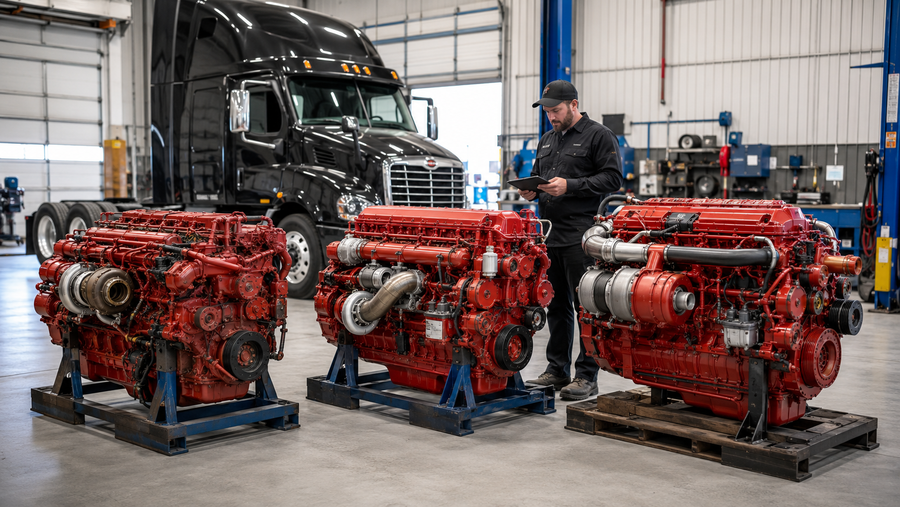
Buying the wrong Cummins long motor rarely causes trouble at invoice stage. The problems usually appear later: during fit-up, parts transfer, emissions alignment, or the first week you need the truck earning again.
The right choice is not always the newest engine or the highest-spec package. It is the exchange path that matches your truck, reduces avoidable workshop time, and makes commercial sense for the way the vehicle works.
At AJK Engines, the main Cummins exchange pathways in this range are ISX EGR, ISX Gen 2 Signature, and X15 E5. Each can suit a different truck, budget, downtime window and long-term plan.
Quick Comparison: ISX EGR vs ISX Gen 2 vs X15
| Factor | ISX EGR | ISX Gen 2 Signature | X15 |
| Typical fit | Older EGR-era trucks | Mid-generation ISX applications | Later trucks suited to newer platforms |
| Main advantage | Straightforward return to service | Balanced generation match | Stronger long-term platform option |
| Main risk | Buying too broadly from the ISX name | Treating it as only a pricing midpoint | Assuming newer always means easier |
| Best suited to | Operators preserving an older asset | Buyers needing the correct middle-generation fit | Fleets planning around longer service life |
| Buying priority | Keep the job clean and controlled | Confirm the right generation before tier | Check electronics, emissions and fit-up requirements |
Start With the Truck, Not the Badge
For most operators, this is a fitment and downtime decision first. Budget comes second.
An older truck with an established emissions setup often points towards staying within the same engine family. A later truck may justify an X15 package if the electronics, emissions hardware and service plan support it.
The mistake is treating ISX EGR, ISX Gen 2 and X15 as interchangeable because they all sit under the Cummins name. They are different buying paths, not just different labels.
Before comparing package tiers, confirm:
- current engine model
- truck details
- emissions setup
- ECM and harness context
- parts transfer requirements
- downtime tolerance
- intended service life
Once the correct platform is clear, choosing between Baseline, Baseline PLUS and Premium becomes much easier.
Package depth should also reflect how hard the truck works. According to the Australian Bureau of Statistics, articulated trucks travelled an average of 78,300 kilometres during the 12 months ended 30 June 2020—more than any other vehicle type. For high-use trucks, this level of utilisation makes expected service life, downtime exposure and package inclusions important considerations when comparing Baseline, Baseline PLUS and Premium.
ISX EGR: Best for Keeping Older Trucks Working
The ISX EGR path usually suits operators keeping an older EGR-era truck in service.
This is often the conservative route. The aim is to restore the truck without turning the job into a wider repower project.
ISX EGR may be the right path when:
- the truck is already built around that era
- the existing setup is worth preserving
- downtime pressure is high
- you want the least disruptive exchange route
- the truck still has enough working life to justify the repair
For many operators, the best outcome is not the newest engine. It is the engine that gets the truck back to work cleanly, without creating extra integration problems.
ISX Gen 2 Signature: The Practical Middle Path
ISX Gen 2 Signature sits between the earlier ISX EGR path and the newer X15 route.
It can suit trucks where an older EGR-era package is not the cleanest match, but X15 is not automatically the right answer either. This is often where generation accuracy matters more than chasing the cheapest quote or newest badge.
ISX Gen 2 Signature may suit buyers who need:
- the correct middle-generation match
- a balanced option between entry cost and long-term use
- a platform choice that suits the existing truck setup
- flexibility to choose a package tier after the engine family is confirmed
Do not treat ISX Gen 2 as simply a pricing midpoint. It should be assessed as its own platform path.
X15: Best When the Truck Supports the Newer Platform
The X15 path usually suits later trucks or operators planning around a newer-generation Cummins platform.
This route is not just about choosing the newest nameplate. X15 packages can involve different expectations around ancillaries, electronics, emissions hardware and fit-up work.
X15 may make sense when:
- the truck already suits the later platform
- the emissions and electronics context support it
- the fleet is planning around longer-term productivity
- the budget allows for a more considered package
- downtime planning is part of the decision, not an afterthought
For high-use fleet vehicles, X15 can be the stronger long-range fit. But the decision still needs to make sense in the workshop and on the balance sheet.
Common Buying Scenarios
The older truck that needs to get back to work fast
If the truck is already built around ISX EGR and the rest of the vehicle still justifies repair, staying within that path may reduce unnecessary disruption.
The goal is not to modernise the truck. The goal is to return it to service with the least avoidable risk.
The truck that sits between generations
If the existing setup does not clearly point to early ISX EGR or X15, ISX Gen 2 Signature may be the cleaner fit.
This is where checking the generation matters. Choosing the wrong path can create extra parts transfer work, delays and avoidable cost.
The fleet truck with a longer service plan
If the vehicle, emissions setup and budget support the newer platform, X15 may be worth considering.
This route can suit operators who are not just solving a breakdown, but planning around future use, reliability expectations and fleet productivity.
Where Buyers Get Into Trouble
The first mistake is buying by model name alone.
The second is treating emissions generation as a minor detail.
The third is comparing package prices without comparing what the truck will need around the engine.
A lower-priced package that fits cleanly can be the better commercial decision. A higher-tier package can also be right, but only when the truck, workload and service plan justify the extra depth.
The wrong choice can add workshop hours, parts complications and time off the road. That is where the real cost appears.
How AJK Engines Helps Narrow the Right Exchange Engine
Our process starts with the truck, not just the engine listing.
We review your current engine details, truck setup, intended outcome, package options and likely fit-up considerations. If the cleanest answer is to stay within the same family, we will say so. If another Cummins generation makes better sense, that decision needs to be practical, not just attractive on paper.
That helps reduce mismatch risk before money, workshop time and downtime are committed.
Questions to Ask Before Choosing a Cummins Exchange Engine
Does my truck need a like-for-like generation match?
In many cases, yes. A like-for-like path can reduce fit-up complexity and downtime. It is especially worth checking if the truck has been modified before.
Should I choose the tier or platform first?
Choose the platform first.
The correct engine family comes before Baseline, Baseline PLUS or Premium. Once the family is confirmed, the package tier decision becomes clearer.
Does newer always mean better?
No. Newer only helps if it suits the truck, emissions context and commercial goal.
A newer platform that creates extra workshop hours can become the slower and more expensive route overall.
What should I have ready before asking for a quote?
Have your truck details, engine model, current failure details and preferred outcome ready.
It also helps to know whether your priority is lowest entry cost, reduced downtime or a stronger long-term package.
The Shortest Route to the Right Cummins Package
If your truck is already built around ISX EGR, forcing a jump to another path without checking the full application can create more cost than it saves.
If your truck sits in the Gen 2 window, that middle route may be the cleanest answer.
If the application supports X15 and the lifecycle plan justifies it, that path may offer the better long-term fit.
The best exchange engine is usually the one that gets the truck back to work with the least disruption, not necessarily the newest or most expensive option.
Send AJK Engines your current engine and truck details, and we can help narrow the Cummins exchange path that makes mechanical and commercial sense for the job.