
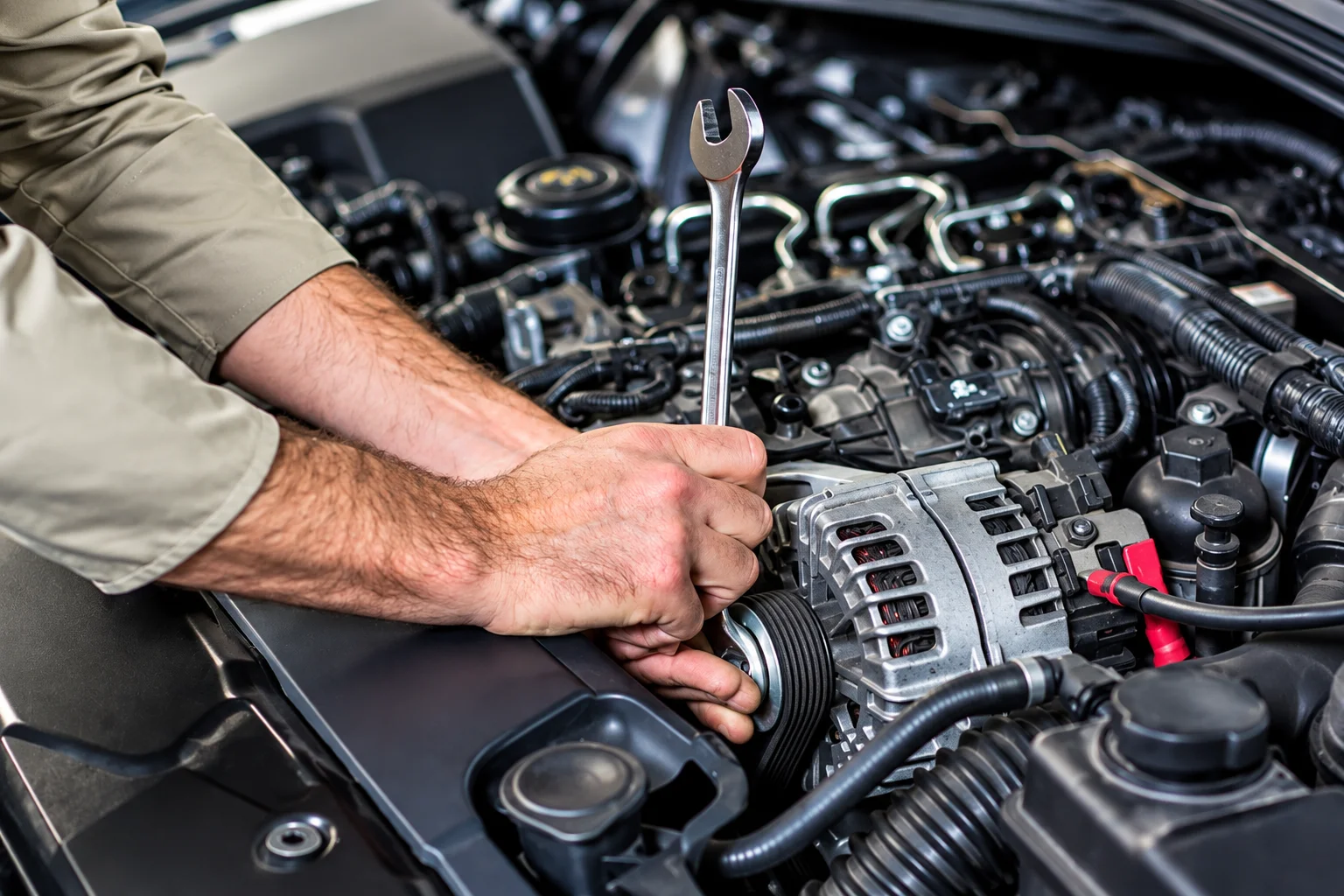
The signs your truck engine needs replacement are rarely limited to one obvious failure. More often, the evidence builds over time.
A repair is followed by another repair. Oil consumption creeps up. The truck no longer pulls quite as well under the same load. Workshop visits become more frequent. Downtime starts interfering with work.
Any one of these symptoms can have a repairable cause. At AJK Engines, we would want to understand the fault before talking seriously about an engine replacement. The more useful question is whether several indicators are beginning to point in the same direction.
That pattern can tell you far more than one breakdown ever will.
Here are seven signs worth watching if you operate, own or maintain a heavy-duty truck.
| Warning sign | What to track |
| Recurring repairs | Fault frequency, repair outcome and downtime |
| Rising oil consumption | Changes from the engine’s normal oil-use pattern |
| Performance loss | Behaviour under similar loads, routes and operating conditions |
| Harder starting | Frequency, cranking time and related symptoms |
| Smoke or blow-by changes | Changes alongside oil use, performance and other symptoms |
| Rising repair spending | Cost compared with the reliability each repair restores |
| Increasing downtime | Vehicle availability and disruption to work |
1. The Repairs Keep Coming Back After the Immediate Fault Is Fixed
Every truck requires repairs eventually. One failed component tells you very little about the overall condition of the engine.
Repeated failures deserve closer attention.
You might repair one problem and return the truck to service, only to have another engine-related issue appear a few weeks later. Then another. The individual jobs may seem unrelated when viewed one invoice at a time, but together they can reveal a broader decline in reliability.
That is where maintenance history becomes useful.
Recurring Diesel Engine Repairs Can Reveal a Larger Pattern
Look back over several months rather than focusing only on the latest workshop bill.
Consider how many engine-related faults have occurred, which systems were involved and whether each repair restored dependable operation or simply bought another short period of service.
A truck that has one significant repair and then runs reliably may still have plenty of useful service ahead.
A truck that keeps returning with different engine problems deserves a deeper assessment.
Start Tracking Repairs by Cause, Cost and Downtime
A simple repair record can make the pattern easier to see.
Record the fault, work performed, cost, time off the road and how long the repair lasted before another problem occurred.
Fleet maintenance systems may already capture much of this information. Owner-drivers can achieve the same result with a straightforward service log.
The aim is to replace guesswork with evidence.
2. Oil Consumption Has Increased Noticeably
A change in engine oil consumption is worth investigating.
Some engines use a predictable amount of oil between services, and operators often become familiar with that baseline over time.
A noticeable increase is different.
Higher oil consumption can have several causes, including external leaks and internal engine or turbocharger-related problems. Diagnosis is required before drawing conclusions about the engine itself.
Compare Current Oil Use With the Engine’s Normal Pattern
Think in terms of change.
Has the truck started needing top-ups more often? Has consumption increased over consecutive service periods? Are you adding considerably more oil while the vehicle continues doing roughly the same work?
Those changes provide useful diagnostic information.
Oil consumption should also be considered alongside other symptoms. Rising oil use combined with smoke, blow-by, reduced performance or recurring repairs may justify a more detailed assessment of internal engine condition.
One measurement rarely settles the question. A consistent change over time provides more useful evidence.
3. The Truck Is Losing Performance Under Familiar Working Conditions
Drivers often notice performance changes before they appear clearly on a maintenance record.
A truck that used to hold speed comfortably on a familiar grade may begin working harder. Throttle response can feel weaker. The vehicle might lose some of its ability to perform under load.
Those observations matter, particularly when the work has stayed broadly the same.
Reduced power can come from many areas. Fuel delivery, air supply, turbocharger operation, electronic controls and emissions systems can all affect performance. Internal engine condition is another possibility.
That makes diagnosis essential.
AJK Engines provides engine diagnostics as part of its broader heavy-duty diesel service capability, alongside repair, overhaul and engine replacement options.
Power Loss Alone Does Not Decide the Fate of an Engine
A truck that feels down on power does not automatically need another engine.
The cause needs to be identified first.
Testing, fault information, operating behaviour and maintenance history can help establish whether the issue sits with a specific repairable component or forms part of broader engine deterioration.
Making a major engine decision before diagnosis can turn an expensive repair into an unnecessary engine purchase.
Compare Performance Under Similar Loads
Driver feedback becomes more useful when conditions are comparable.
Consider the same route, similar gross weight and familiar operating conditions. A consistent performance decline under circumstances the truck previously handled comfortably is more meaningful than one poor run under unusually difficult conditions.
4. Starting Has Become Harder and the Engine Takes Longer to Settle
Starting behaviour often becomes so familiar that a change is immediately noticeable.
The engine might crank longer. Cold starts may become more difficult. Idle quality may be rougher after startup. The engine may take longer to settle into its usual operating rhythm.
Several systems can create these symptoms.
Battery condition, starter performance, fuel delivery, ambient temperature and other faults all need to be considered before blaming the engine internally.
A sustained change from normal behaviour still deserves investigation.
One Difficult Start Means Less Than an Ongoing Change
Context matters.
A hard start on an unusually cold morning is different from a truck that becomes progressively harder to start over several weeks.
Look for repeatability.
Does the problem happen every morning? Is it worse after the vehicle sits? Has cranking time increased gradually? Is starting difficulty appearing alongside smoke, oil consumption or performance loss?
Those details turn a vague complaint into something a technician can investigate properly.
5. Smoke, Blow-By or Other Engine Behaviour Has Changed
Changes in exhaust smoke or crankcase behaviour can provide further clues about engine condition.
They should be treated as clues rather than a diagnosis.
Smoke colour by itself does not provide a complete answer. Fuel problems, air supply issues, operating temperature, injectors, turbocharger faults and internal engine condition can all influence what comes out of the exhaust.
Blow-by also needs context.
A noticeable increase in crankcase pressure or vapour may justify further testing, particularly if other symptoms are present.
Smoke Is One Piece of Diagnostic Evidence
A useful assessment combines several observations.
A technician may consider smoke alongside oil consumption, compression, fault information, operating performance and other inspection findings.
That combined approach is more useful than seeing smoke and deciding immediately that the engine is worn out.
Commercial engine decisions are expensive. They deserve more evidence than one visual symptom.
Several Symptoms Together Carry More Weight
Consider two trucks.
Truck A develops visible smoke but continues performing normally, oil consumption remains stable and diagnosis identifies a specific repairable fault.
Truck B develops increasing smoke, higher oil consumption, more blow-by, weaker performance and repeated engine-related failures.
The second situation presents a broader set of warning signs. It still requires diagnosis, but there is more reason to assess the condition of the engine as a whole.
6. Repair Spending Is Rising While Reliability Keeps Falling
An engine can remain technically repairable for a long time.
The commercial decision can become harder.
A repair may solve the immediate failure yet produce little improvement in long-term reliability. Another issue appears. Another invoice follows. The vehicle returns to the workshop.
Eventually, operators need to consider what that repair spending is actually buying them.
Repair Cost Is Only One Part of the Calculation
The workshop invoice is easy to see.
The surrounding costs can be less obvious.
A truck off the road may disrupt schedules, require another vehicle to cover the work, delay deliveries or reduce fleet capacity. An owner-driver can feel the effect even more directly because the truck may be the primary income-producing asset.
These costs vary between businesses, so there is no universal figure at which repair stops making sense.
Instead, look at the circumstances of the individual truck. Consider recent engine repair costs, downtime, reliability after each repair and the work the vehicle still needs to perform over the coming years.
Maintenance Records Can Show Whether Repairs Are Restoring Reliability
A rising repair bill does not automatically support replacement.
A major repair that restores dependable service can still be commercially sensible.
Repeated spending with declining reliability creates a different picture.
Review the sequence rather than adding invoices without context. The question is whether the repairs are improving the condition of the truck enough to justify the cost and disruption.
7. Downtime Has Become the Engine Problem That Costs the Most
Eventually, the issue may stop being individual components.
It becomes availability.
A commercial truck earns its keep by being available for work. Repeated engine trouble can undermine that even if each individual fault remains repairable.
The scale of road transport in Australia puts vehicle availability into perspective. BITRE estimates that vehicles travelled approximately 264 billion kilometres on Australian roads during 2024–25. For commercial operators, keeping working vehicles available is therefore an important operational consideration.
This is one reason AJK Engines’ service model includes exchange engines and drive-in drive-out engine fitting. The exchange approach can provide another pathway where ongoing engine problems make a broader solution worth assessing.
The Decision Starts to Centre on Keeping the Truck Productive
There is a practical difference between asking, “Can this fault be repaired?” and asking, “What option gives this truck a sensible path back to dependable service?”
A repair may still be the correct answer.
An engine overhaul could also be suitable.
A truck engine replacement or exchange engine may become worth comparing where failures, repair spending and downtime have begun accumulating.
The decision needs to consider both the mechanical condition and the commercial job the truck still has to do.
One Warning Sign Rarely Decides It
Engine replacement becomes worth assessing when several warning signs begin moving in the wrong direction at the same time.
Repair frequency may increase while oil consumption rises. Drivers may report weaker performance or harder starting. Workshop records may show more expensive repairs with shorter periods of reliable service between them.
None of these signs provides a diagnosis on its own.
Together, however, they give you a reason to assess the engine as a whole rather than treating each new fault in isolation.
Use the truck’s repair history, operating behaviour and downtime record to build that picture before deciding whether repair, rebuild or replacement deserves closer consideration.
Diagnosis Comes Before a Heavy-Duty Engine Replacement
Replacing a heavy-duty diesel engine is a significant decision.
We prefer to start with the fault.
AJK Engines works across diagnostics, engine repair and overhaul, reconditioning, exchange engines and fitting services. That provides several possible pathways depending on what the inspection shows.
An isolated component failure may have a straightforward repair solution. More extensive internal wear may justify deeper engine work. A truck with repeated failures, deteriorating reliability and costly downtime may make an exchange or heavy-duty engine replacement worth comparing.
The diagnosis determines which conversation makes sense.
Some Engine Problems Still Make Sense to Repair
Replacement should never be assumed purely because an engine has developed a fault.
A specific failure in an otherwise serviceable engine can be very different from widespread wear or repeated problems across multiple systems.
Vehicle age alone is not enough either.
The engine’s actual condition, repair history, truck application and future plans all deserve consideration.
Replacement Becomes Worth Comparing as Problems Stop Being Isolated
When repeated repairs, worsening oil consumption, performance deterioration and regular downtime begin appearing together, there is more reason to assess the engine as a complete unit.
At that stage, comparing repair, rebuild and replacement paths can help clarify the available options before another breakdown determines the timing.
Repair, Rebuild or Replace the Diesel Engine?
These options solve different problems.
A repair targets a defined fault where the broader engine remains suitable for continued service.
A rebuild or reconditioning process involves deeper engine work, including inspection and preparation of major internal components. AJK’s reconditioning process includes teardown, component assessment, cleaning, crack testing, machining where required and reassembly.
An engine replacement involves installing another engine. AJK also supplies heavy-duty engines on an exchange basis, where the customer’s existing unit is returned as the exchange core.
Each route comes with different practical considerations.
Engine condition matters. So do parts availability, repair scope, downtime, the truck’s planned service life and the work it needs to return to.
The cheapest invoice today and the best operating decision over the next few years can produce different answers.
We Look at the Engine, the Truck and the Work It Still Needs to Do
An engine does not operate in isolation.
We want to know what it is fitted to, what has gone wrong, how often problems are occurring and what the truck is expected to do after the repair.
Useful information includes the engine make and model, truck make and model, recent fault history, repair records, oil consumption changes and any performance concerns.
That gives us a much stronger starting point.
You can browse our current heavy-duty engine range if you are beginning to research replacement options.
For operators focused on preventing failures and improving availability, our guide to reducing downtime and improving diesel engine reliability provides further practical context.
Questions Truck Operators Usually Ask Before Replacement Becomes a Real Conversation
Does High Oil Consumption Mean My Diesel Engine Needs Replacing?
No single oil-consumption reading can answer that question.
Increased oil use should be investigated to identify the cause. The information becomes more significant when consumption is rising consistently and appears alongside other signs such as smoke, blow-by, performance loss or repeated engine problems.
How Many Engine Repairs Are Too Many?
There is no fixed number.
Look at the type of failures, total repair spending, frequency of downtime and how much dependable service each repair restores. Three minor unrelated jobs can present a very different situation from three major engine failures within a short period.
Is Loss of Power a Sign That My Engine Is Worn Out?
It can form part of the picture, although many faults outside the engine’s core components can reduce performance.
Fuel, air, turbocharger, electronic and emissions-related problems may all affect power. Diagnosis should identify the cause before an engine replacement is considered.
Can an Older Diesel Engine Still Be Worth Repairing?
Yes. Age alone does not establish engine condition.
A repair can remain sensible if the fault is well defined, the wider engine is serviceable and the truck still makes commercial sense to operate.
Should I Replace the Engine Before It Completely Fails?
That depends on the evidence.
Operators experiencing worsening reliability may benefit from assessing repair, rebuild and replacement options before another unplanned breakdown determines the timing. A planned assessment gives you more opportunity to compare the available options.
What Information Helps Determine Whether an Engine Should Be Repaired or Replaced?
Engine and truck identification, service history, recent repair work, oil consumption, fault codes, performance changes, smoke or blow-by observations and operating application all provide useful context.
The more specific the information, the easier it is to investigate the actual problem.
What Is the Difference Between Rebuilding and Replacing a Truck Engine?
A rebuild works with the existing engine and restores its components according to the required scope.
Replacement involves fitting another engine or exchange unit.
The practical choice depends on the existing engine’s condition, available packages, repair requirements and how quickly the truck needs to return to service.
Can AJK Engines Supply and Fit Replacement Engines?
AJK Engines supplies new, remanufactured and reconditioned heavy-duty diesel engines across supported platforms and offers engine fitting, including drive-in drive-out replacement services where applicable.
Read the Pattern Before the Next Breakdown Makes the Decision for You
A single hard start does not mean the engine is finished. Neither does one oil leak, one repair or one poor day under load.
Repeated problems deserve closer assessment.
If repair frequency is climbing while oil use changes, performance falls away, starting behaviour deteriorates and downtime increases, it may be time to assess the condition of the engine as a whole.
Diagnosis may still lead to a repair. It may support a rebuild. It may show that a heavy-duty engine replacement or exchange engine deserves consideration.
The aim is to understand the condition of the engine before another failure forces the timing of the decision.
Browse our engine range or contact AJK Engines with your truck details, engine information and recent symptoms to discuss the available options.