
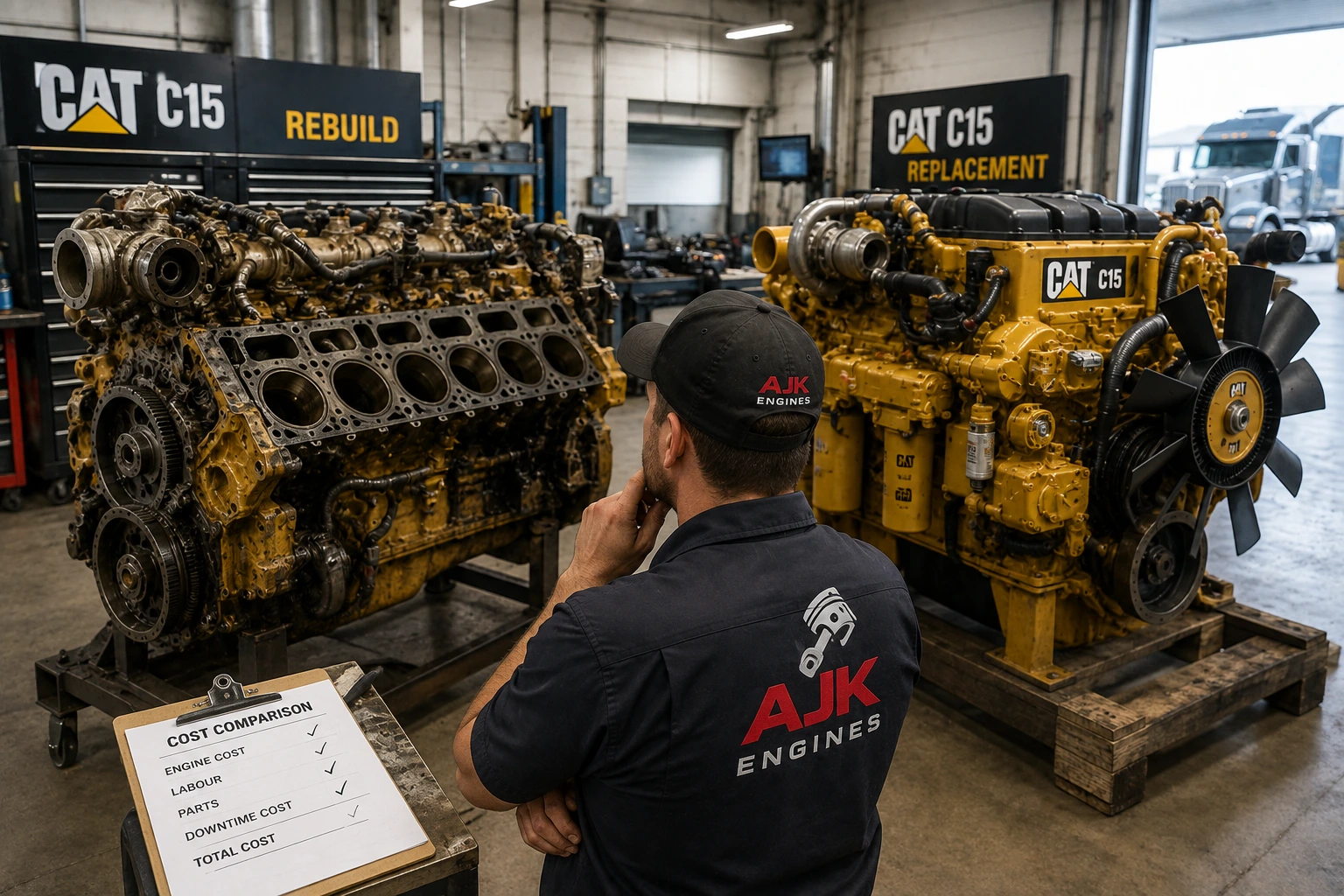
When a CAT C15 develops a serious fault, the immediate question is often whether rebuilding the existing engine will cost less than replacing it.
The workshop invoice is only part of the calculation.
You also need to consider how long the truck will remain off the road, what further damage may be discovered during inspection and how much disruption the wider operation can absorb.
A rebuild may have a lower starting price. However, it can become the more expensive route if the scope grows after teardown or the truck remains idle for longer than expected.
A replacement engine may cost more initially but offer a more predictable route back into service when downtime tolerance is low.
In this guide, replacement primarily means fitting a suitable exchange or remanufactured CAT C15 engine. The right option will depend on the engine specification, condition, diagnosis, package availability and fitting requirements.
There is no universally cheaper choice. The better financial decision is the option with the lowest total cost once downtime, fitting, transport, inspection risk and possible additional charges are included.
Start With the Cost of Downtime
A CAT C15 failure becomes a commercial problem as soon as the truck stops working.
The scale of Australia’s road freight task provides context for the operational importance of heavy vehicles. The Australian Government’s Bureau of Infrastructure and Transport Research Economics estimated that road transport carried approximately 253 billion tonne-kilometres of domestic freight in 2024–25. For an individual operator, an engine failure removes productive vehicle capacity from this wider freight network until the truck can return to service.
While the final repair cost may still be uncertain, downtime costs can begin immediately through:
- lost jobs or reduced earning capacity
- replacement vehicle hire
- driver and workshop downtime
- overtime and rescheduling
- recovery and transport costs
- additional pressure on other trucks in the fleet
- missed delivery windows
- customer service problems
A useful starting calculation is:
Estimated downtime cost = lost daily contribution × days off the road + additional operating and recovery costs
Start by estimating how much the truck normally contributes during each working day.
This should not be confused with turnover alone. Where possible, use the contribution the vehicle makes after direct operating costs. Then multiply that figure by the expected number of working days off the road.
Add any likely costs for:
- vehicle hire
- recovery
- transport
- overtime
- subcontracted work
- rescheduling
- additional fleet mileage
This estimate will not predict every cost, but it provides a more realistic comparison than looking at the engine invoice alone.
For each option, calculate:
Rebuild total cost = rebuild quote + expected downtime cost + fitting and transport + contingency for additional work
Replacement total cost = engine package + expected downtime cost + fitting and transport + applicable core-related charges
Use the same assumptions for both options. Comparing a complete replacement quote with an incomplete rebuild estimate will produce a misleading result.
When Rebuilding a CAT C15 Still Makes Sense
A rebuild can be the right option when the existing engine remains a viable foundation for the work.
It is usually most suitable when:
- the engine core appears serviceable
- the failure is reasonably contained
- major hard parts are expected to be reusable
- the business can tolerate the inspection and repair period
- retaining the original engine matters
- the likely scope is understood before work begins
- the workshop has the capacity and parts needed to complete the job
The strongest rebuild cases are planned rather than reactive.
The operator has time to inspect the engine, review the likely scope and allow for reasonable movement in the final cost.
The main risk is that a rebuild estimate depends on what is found after teardown.
An initial diagnosis may not reveal the full condition of the block, cylinder head, crankshaft or other major components. Further damage can increase the parts, machining and labour required.
The original estimate may then rise, while the truck remains off the road for longer.
That uncertainty does not make rebuilding the wrong choice. It means the decision should be based on the probable condition of the engine rather than the starting estimate alone.
Before approving a rebuild, ask the workshop which findings could change:
- the quoted price
- the completion date
- the parts requirement
- the warranty offered
- the overall viability of the repair
When an Exchange Engine Becomes the Lower-Risk Option
An exchange engine may offer a more predictable route when downtime tolerance is low or the extent of the internal damage remains unclear.
Replacement is often worth considering when:
- the engine has a complicated or uncertain failure history
- teardown may reveal extensive damage
- the truck needs to return to work quickly
- the business cannot carry an open-ended repair period
- repeated repairs have reduced confidence in the existing engine
- a correctly specified exchange engine is available
- the likely rebuild cost is already close to the replacement cost
An exchange engine does not remove every variable.
You still need to confirm:
- the exact engine specification
- compatibility with the truck
- package availability
- fitting requirements
- ancillary components
- transport arrangements
- returned-core conditions
- warranty terms
- testing and commissioning requirements
However, an exchange engine can provide a more defined starting scope than a rebuild that depends heavily on inspection findings.
Depending on the supplier and package, fitting support, testing or warranty cover may be available. These should never be assumed.
Ask for a written breakdown of what is included, what is excluded and what could change the final price.
Additional charges may also apply if the returned core or major components do not meet the agreed conditions. The applicable terms should be confirmed before the engine is ordered.
CAT C15 Rebuild vs Exchange Engine
The table below provides a practical comparison. It is a decision aid rather than a substitute for an engine inspection or written quotation.
|
Cost and decision factor |
Rebuild |
Exchange engine |
| Starting price | May be lower when the core and major components are serviceable | May have a higher initial package price |
| Final cost certainty | Can change after teardown and inspection | May be more defined, but fitting and core-related adjustments can still apply |
| Downtime | Depends on inspection, machining, parts and workshop capacity | May be shorter when the correct engine is available and ready for fitting |
| Main financial risk | Additional damage increases parts, machining and labour | Returned-core condition, specification errors, fitting work or availability increase costs |
| Best suited to | A serviceable core, contained damage and manageable downtime | Uncertain internal damage or a business that needs a more predictable return to service |
| What must be confirmed | Inspection scope, reusable components, parts availability and completion time | Specification, availability, package contents, core terms, fitting and warranty |
| Commercial advantage | Retains the existing engine and may provide good value when damage is limited | Can reduce exposure to an expanding repair scope and extended downtime |
The lower starting quote should not decide the outcome on its own.
For example, a rebuild may remain the better option when the core is sound and the additional downtime cost is modest.
An exchange engine may cost less overall when its higher initial price is offset by a significantly faster and more predictable return to service.
Use confirmed figures wherever possible:
- written rebuild estimate
- written exchange-engine quotation
- realistic lead time
- realistic installation time
- expected testing period
- daily vehicle contribution
- transport and recovery costs
- possible rebuild contingency
- possible returned-core adjustments
How Delaying the Decision Can Increase the Cost
Waiting does not always cause further mechanical damage, but it can reduce commercial flexibility.
A planned job gives you time to:
- confirm the engine specification
- assess the existing core
- compare rebuild and exchange options
- check engine and parts availability
- organise transport and fitting
- adjust fleet schedules
- review warranty and exchange terms
- prepare for possible additional work
An emergency job gives you fewer choices.
Once the truck is already off the road and work is being missed, speed may become more important than price.
The business may have less time to compare suppliers, confirm package details, arrange a suitable engine or schedule the work around quieter periods.
The decision can then become whichever option can be organised fastest, rather than the option offering the best overall value.
Acting early does not mean committing before the fault is understood. It means gathering the information needed while the business still has room to compare the available options.
What to Check Before You Commit
1. Which CAT C15 engine do you have?
Confirm the engine model, serial details and truck application.
Descriptions such as CAT C15 9NZ and CAT C15 ACERT should not be treated as interchangeable. Accurate engine information is essential when discussing parts, compatibility, exchange availability and fitting.
Do not order an engine or approve major work using the truck model alone.
2. How serviceable is the existing core?
The condition of the block, cylinder head, crankshaft and other major components can affect both rebuild viability and possible exchange-engine charges.
A core that appears complete may still contain internal damage that only becomes clear after inspection.
Ask which components must be serviceable and how their condition will be assessed.
3. How confident is the diagnosis?
A known, contained fault is easier to price than an engine with an unclear history, multiple symptoms or previous repair problems.
Ask:
- what has been tested
- what has been confirmed
- what remains unknown
- whether the engine needs to be stripped for a reliable assessment
- which findings could materially increase the scope
- whether previous repairs may affect the work
A diagnosis should identify the limits of what is known. It should not create false certainty before the engine has been properly inspected.
4. How much downtime can the business carry?
Set a realistic maximum.
Do not base this only on the workshop’s estimated labour time. Consider:
- engine availability
- parts supply
- machining
- workshop capacity
- removal and installation
- transport
- testing
- commissioning
- possible delays after further inspection
A four-day engine job can still create longer commercial downtime if the engine, parts or transport are not ready when needed.
5. What is included in the quote?
Check whether the price includes:
- engine removal
- engine installation
- freight
- recovery
- fluids and filters
- replacement ancillaries
- machining
- testing
- commissioning
- returned-core charges or deposits
- warranty cover
- applicable taxes
- exclusions and conditions
Two quotes can look similar while covering very different amounts of work.
Ask for both quotes to be presented on a comparable basis.
6. What happens if further damage is found?
For a rebuild, ask which inspection findings could change the quotation or completion date.
For an exchange engine, ask how the returned core will be assessed and what conditions could affect the final charge.
The answer should be documented before work begins.
A clear escalation process also helps. Confirm who will contact you, what evidence will be provided and whether written approval is required before additional work is carried out.
Choose the Option That Controls the Whole Cost
The cheaper engine option is not always the cheaper business decision.
A rebuild may offer strong value when:
- the core is serviceable
- the fault is contained
- major components can be reused
- the likely scope is understood
- the truck can remain off the road long enough for the work to be completed properly
An exchange engine may offer better commercial control when:
- internal damage is uncertain
- the rebuild scope could expand significantly
- the truck is already causing operational disruption
- the business needs a more predictable return to service
- an appropriate engine is available
- the package terms are clear
The decision should account for:
- the starting repair or engine cost
- possible increases after inspection
- expected downtime
- the truck’s daily contribution
- disruption to the wider fleet
- fitting requirements
- transport and recovery
- parts or engine availability
- warranty conditions
- returned-core conditions
Calculate the total likely cost for both routes and compare the risks around each figure.
A lower rebuild estimate may still represent the better choice. A higher-priced exchange engine may also cost less overall when it materially reduces downtime and uncertainty.
The answer depends on the numbers and conditions attached to the individual engine and operation.
Request a CAT C15 Rebuild or Exchange Assessment
Deal with the decision while you still have time to compare the options properly.
To assess the most suitable route, provide:
- CAT C15 model or engine serial details
- truck make and model
- current symptoms
- any diagnosis or inspection findings
- details of previous repairs where relevant
- location of the truck
- required turnaround
- whether recovery is needed
- whether removal and fitting are required
These details make it easier to determine whether rebuilding the existing engine remains commercially sensible or whether a suitable exchange engine may offer a more predictable route.
Ask for the assessment to explain:
- the recommended option
- the known costs
- the possible additional costs
- the expected turnaround
- the information that still needs to be confirmed
- the applicable warranty and returned-core terms
The strongest decision is one based on a confirmed engine specification, a realistic assessment of the core and a clear understanding of how much downtime the business can carry.
Frequently Asked Questions
When is a CAT C15 rebuild worth doing?
A rebuild may be worthwhile when the engine core remains serviceable, the damage appears contained and the business can tolerate the time required for inspection and repair.
The condition of the major components should be assessed before relying on the initial estimate.
When should I consider a CAT C15 exchange engine?
An exchange engine may be worth considering when downtime must be controlled, the internal damage is uncertain or further discoveries during teardown could significantly extend the repair.
Availability, specification, fitting requirements, package contents and returned-core terms should be confirmed before proceeding.
Should I include downtime when comparing rebuild and replacement costs?
Yes.
Lost contribution, replacement vehicle costs, recovery, overtime, rescheduling and disruption to the wider fleet can materially affect the true cost of either option.
Compare the total business cost rather than the engine invoices alone.
What details are needed to assess the right option?
Provide the engine model or serial details, truck make and model, symptoms, diagnosis, location, required turnaround and whether recovery, removal or fitting are needed.
Details of previous repairs may also help when the failure history is complicated.