
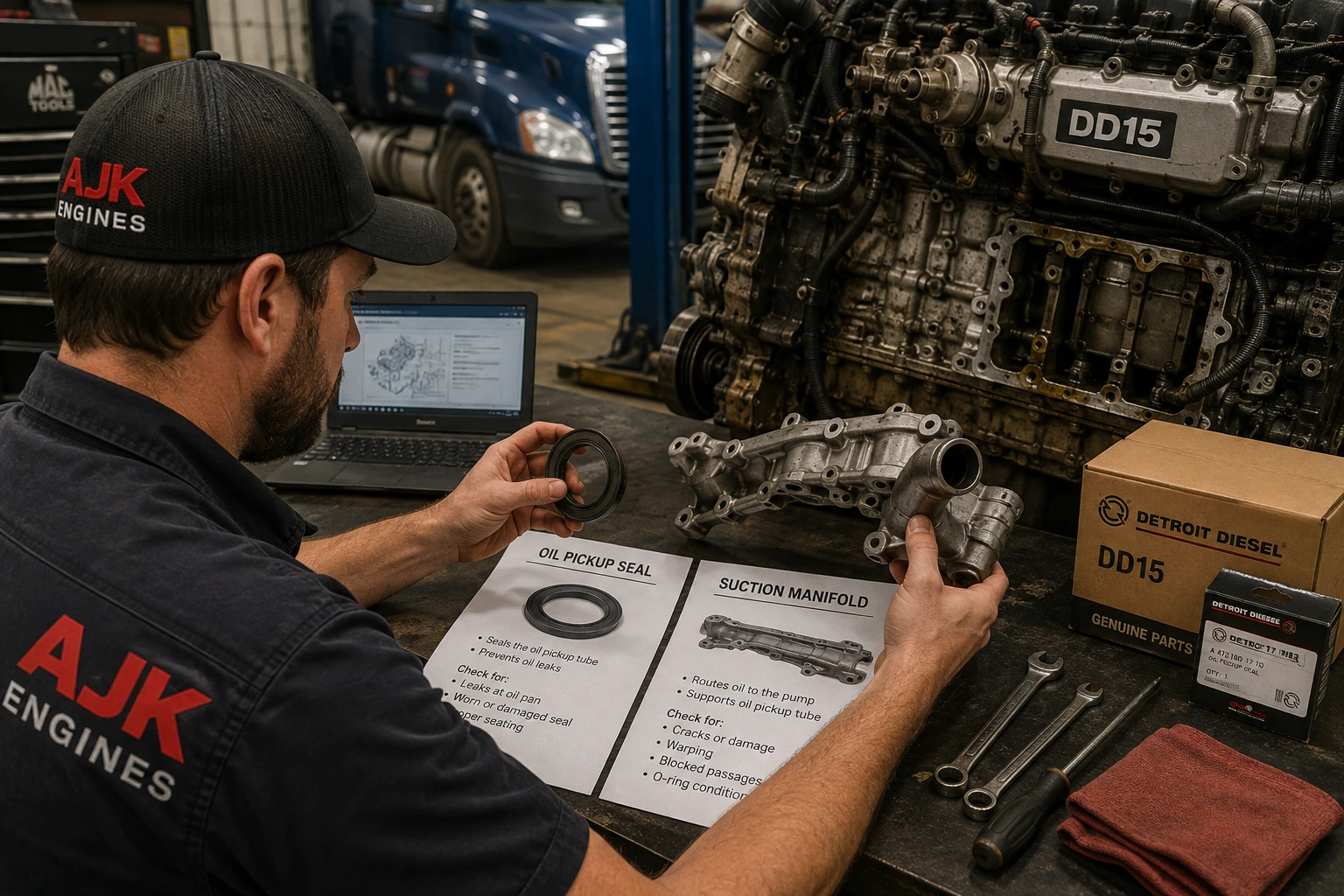
A DD15 oil-system fault can seem straightforward, but workshop descriptions often blur the distinction between two nearby components.
One person may suspect the oil pickup seal. Another may refer to the suction manifold. Both parts sit within the engine’s oil supply system, but they perform different functions and should not be treated as interchangeable.
Ordering from a vague description such as “a leak near the pickup area” can lead to the wrong part, repeat labour and unnecessary downtime. Before placing an order, confirm whether the inspection points to the pickup-tube sealing point, the suction manifold or another part of the oil system.
The Difference Between the Two Parts
The simplest distinction is:
- The oil pickup seal seals the pickup-tube connection.
- The suction manifold is a larger component within the oil suction pathway.
A failed seal requires a different repair from a damaged or unserviceable manifold. Replacing the seal will not correct a fault in the manifold itself. Equally, replacing the manifold may be unnecessary when the problem is limited to the sealing point.
What the DD15 Oil Pickup Seal Does
The Detroit Oil Pick Up Tube Seal A4721880180 is a sealing component used at the pickup-tube connection on applicable DD13 and DD15 engines.
It may be relevant when inspection identifies a problem at that connection, including:
- A damaged or deteriorated seal
- Poor seating at the pickup-tube joint
- Damage to the sealing surface
- Evidence that the connection is not sealing correctly
The seal is the smaller component, but it should not be ordered without confirming the fault. Replacing it will not resolve a problem elsewhere in the suction pathway.
What the DD15 Suction Manifold Does
The Detroit Suction Manifold A4721805551 is listed for applicable DD13, DD15 and DD16 engines.
Unlike the pickup seal, the manifold is a larger component within the oil suction system. It should be investigated when inspection raises concern about the manifold itself or its connection points.
Replacement may be appropriate when the manifold is confirmed as damaged, unserviceable or responsible for the fault. Do not assume that every concern near the pickup area requires a manifold.
Part fitment should always be confirmed using the engine model, serial information and relevant parts data.
Why These Faults Can Be Confused
Workshop descriptions do not always identify the failed component precisely.
Terms such as “pickup leak”, “suction-side issue” or “oil leak around the pickup” may describe the general location rather than the confirmed cause. Oil can also travel across nearby surfaces, making the visible leak location different from the original source.
An external oil leak, a suction-side sealing fault and an oil-pressure concern are not automatically the same problem. Before ordering either part, establish what the workshop has inspected and confirmed.
What to Check Before Ordering
Mechanical inspection remains a central part of keeping Australia’s heavy vehicle fleet roadworthy. During the 2024 National Roadworthiness Survey, the National Heavy Vehicle Regulator inspected 9,082 heavy vehicles and combinations across Australia. While 75% passed, one in four did not, reinforcing the need to base repair and parts decisions on confirmed mechanical findings.
For a DD15 oil-system concern, this means identifying the precise fault before choosing between the pickup-tube seal, suction manifold or another component within the system.
Identify the Type of Fault
Confirm whether the truck has:
- A visible external oil leak
- Low or unstable oil pressure
- Suspected air entry on the suction side
- Physical damage found during disassembly
- A recurring fault after previous work
A visible leak alone may not isolate the failed component. An oil-pressure symptom should not be treated as proof that either the pickup seal or suction manifold is responsible.
Inspect the Pickup-Tube Connection
Check the pickup-tube sealing point and surrounding surfaces according to the correct workshop procedure.
Look for:
- Seal deterioration or damage
- Poor alignment or seating
- Damage to the sealing surfaces
- Evidence that the joint is not sealing correctly
- Signs of previous installation problems
The Detroit Oil Pick Up Tube Seal A4721880180 is the relevant replacement only when inspection confirms that the sealing point is the issue.
Inspect the Suction Manifold
Inspect the manifold and its connection points for damage or conditions that could prevent correct operation or sealing.
Do not replace the manifold based only on the general location of the leak. Confirm that the component itself is damaged or unserviceable before ordering a replacement.
When the inspection findings remain unclear, follow the applicable workshop procedure or obtain technical advice before committing to a part.
Check Previous Repair History
Previous work may help narrow the fault.
Ask:
- Has the pickup seal already been replaced?
- Was the manifold removed or inspected during the earlier repair?
- Did the problem return immediately or after further use?
- Were the sealing surfaces checked?
- Were the correct installation procedures followed?
A recurring issue after a limited repair may justify broader inspection, but it does not prove that the manifold is at fault.
Confirm the Correct Part Number
Do not rely on the DD15 engine name alone.
Before ordering, confirm:
- Engine model
- Engine serial number
- Truck application
- Existing part number, where available
- Current OEM or supplier cross-reference information
Model applications and component specifications can vary. Confirming fitment before ordering is usually faster and cheaper than repeating the repair.
DD15 Oil Pickup Seal vs Suction Manifold
| Check | Oil pickup seal | Suction manifold |
| Component type | Sealing component | Larger oil suction component |
| Main role | Seals the pickup-tube connection | Forms part of the oil suction pathway |
| Relevant part number | A4721880180 | A4721805551 |
| Listed applications | Applicable DD13 and DD15 engines | Applicable DD13, DD15 and DD16 engines |
| Replace when | The sealing point is confirmed as faulty | The manifold is confirmed as damaged or unserviceable |
| Do not order based only on | A vague reference to the pickup area | A general oil leak near the suction system |
What Happens When the Wrong Part Is Ordered
The cost of a wrong order is rarely limited to the part itself.
It can also create:
- Repeat disassembly
- Additional workshop labour
- Delayed vehicle scheduling
- Freight and return costs
- Longer truck downtime
- Disputes between the workshop, customer and parts supplier
The safest approach is to match the ordered part to a confirmed inspection finding rather than the most convenient initial assumption.
When a Visual Check Is Not Enough
Oil migration can make the source difficult to identify. Nearby components may become coated, and previous repairs can further complicate the inspection.
A visual check may help identify the general area, but it may not confirm whether the fault involves:
- The pickup seal
- The manifold
- A nearby joint or component
- An internal suction-side sealing issue
- A separate cause of low oil pressure
When the evidence does not clearly isolate the failed part, confirm the fault before ordering. This is usually more efficient than repeating the labour.
DD15 Oil-System Parts Available from AJK Engines
Detroit Oil Pick Up Tube Seal A4721880180
This seal is listed for applicable DD13 and DD15 pickup-tube applications.
It may be the relevant option when inspection confirms a fault at the pickup-tube sealing point.
Detroit Suction Manifold A4721805551
This suction manifold is listed for applicable DD13, DD15 and DD16 applications.
It may be the relevant option when inspection confirms that the manifold is damaged or unserviceable.
Fitment must be checked before either part is ordered.
Frequently Asked Questions
Can a pickup-seal fault look like a suction-manifold problem?
Yes. The components sit within the same broader oil-suction area, and workshop descriptions may not identify the exact failed part. Oil migration can also make the visible source difficult to confirm.
Inspection is required before choosing between them.
Does an external oil leak confirm that the pickup seal has failed?
No. An external leak near the pickup area does not prove that the seal is responsible. The connection, surrounding components and oil path should be inspected before ordering.
When should the suction manifold be replaced?
Replace it when the manifold is confirmed as damaged, unserviceable or responsible for the fault. Do not order it solely because the concern has been described as a suction-side or pickup-area issue.
What information should I have ready before ordering?
Have the following details available:
- Engine model
- Engine serial number
- Truck make and model
- Existing part number, if visible
- Workshop inspection findings
- Details of previous related repairs
This information helps confirm fitment and reduces the risk of ordering the wrong component.
Order the Part That Matches the Inspection
Do not choose between the DD15 oil pickup tube seal and suction manifold based only on the visible leak location or a general workshop description.
When inspection confirms a fault at the pickup-tube connection, the Detroit Oil Pick Up Tube Seal A4721880180 may be the correct replacement. When the manifold itself is confirmed as damaged or unserviceable, the Detroit Suction Manifold A4721805551 may be required.
Before ordering, have the engine model, engine serial number, truck details, existing part number and workshop findings ready. This will help AJK Engines confirm fitment and reduce the risk of delays or repeat labour.
For parts and fitment assistance, contact AJK Engines:
Phone: 07 5529 2289
Email: horsepower@ajkengines.com.au
Address: 45/211 Brisbane Road, Biggera Waters QLD 4216