
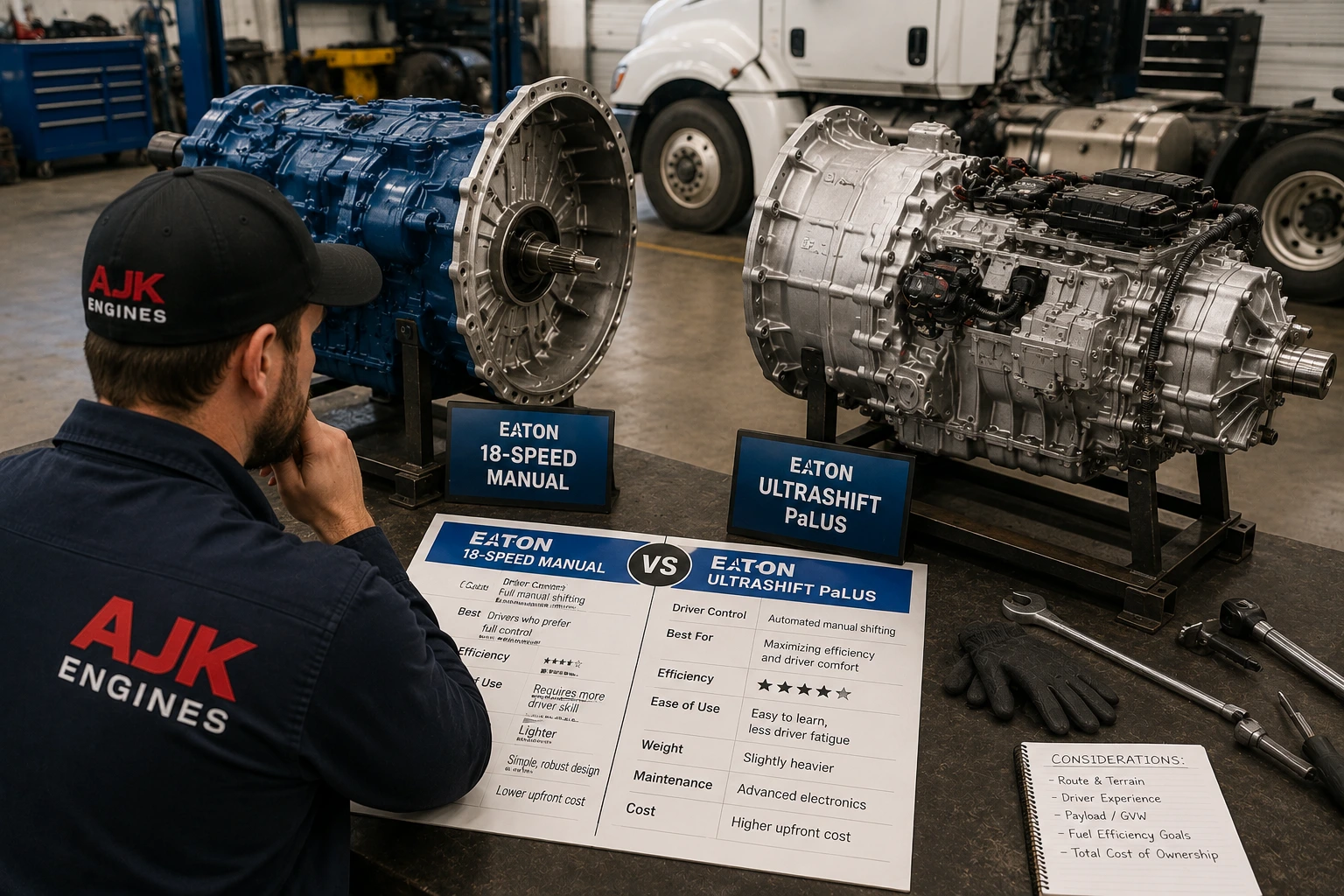
Choosing an Eaton 18-speed transmission is not simply a matter of deciding how many gears you need. The more important question is how the transmission fits the truck, its workload and the people operating it.
An Eaton Fuller manual 18-speed gives the driver direct control over gear selection. An UltraShift PLUS automated manual transmission manages clutch actuation and shifting electronically, while also providing driver-selectable operating modes.
Neither format is automatically better. The right choice depends on torque capacity, vehicle compatibility, duty cycle, route conditions, driver experience and maintenance support. Confirm those factors before comparing price or shift preference.
Start With Technical Suitability
Before choosing between manual and automated shifting, confirm that the exact transmission model suits the truck and its intended application.
For a direct comparison within the 2,050 lb-ft torque class, two relevant options are:
- Eaton Fuller RTLO-20918B manual 18-speed transmission
- Eaton Fuller UltraShift PLUS FO-20E318B-MXP automated manual transmission
Eaton’s transmission specifications list both models with a maximum torque capacity of 2,050 lb-ft. Comparing models in the same torque class helps separate the shift-format decision from differences in rated capacity.
The torque rating alone does not confirm fitment. Check:
- Current transmission model, serial number and identification tag
- Engine make, model and rated torque output
- Truck make, model and year
- Axle configuration and ratios
- Gross vehicle or combination weight
- Normal load and operating conditions
- Clutch and control requirements
- Mechanical mounting compatibility
- Electronic and software compatibility
- Installation, programming and calibration requirements
A transmission may appear suitable from its headline specifications but still require different controls, wiring, clutch components or installation work. Verify the complete application before ordering.
It is also important to understand the product’s current status. Eaton Cummins states that UltraShift PLUS became obsolete at the end of 2023 and was replaced for new applications by the Endurant family. This comparison is therefore most relevant when assessing an existing UltraShift PLUS-equipped truck or a compatible remanufactured replacement.
Eaton 18-Speed Manual vs UltraShift PLUS at a Glance
| Factor | Eaton Fuller RTLO-20918B manual | UltraShift PLUS FO-20E318B-MXP |
| Transmission type | Manual 18-speed | Automated manual 18-speed |
| Maximum torque rating | 2,050 lb-ft | 2,050 lb-ft |
| Shift operation | Driver controls the clutch and completes each shift | System automates clutch actuation and gear changes |
| Driver input | Direct gear-selection control | Automatic operation with manual and low modes, subject to configuration |
| Driver workload | More frequent physical input | Less physical shifting work |
| Operator consistency | Depends more heavily on individual technique | Can provide more consistent shifting between drivers |
| System requirements | Primarily mechanical fitment and clutch compatibility | Mechanical, electrical, clutch-actuation, software and control compatibility |
| Typical consideration | Existing manual configuration and experienced manual drivers | Existing UltraShift PLUS configuration, multi-driver use or reduced shift workload |
Eaton’s driver instructions confirm that UltraShift PLUS can operate in manual mode, allowing the driver to request shifts using the controls. The permitted behaviour can vary according to the vehicle’s configuration and transmission-protection settings.
This table is a starting point. A fitment assessment is still required before either transmission is ordered.
What an Eaton Fuller Manual 18-Speed Offers
A manual Eaton Fuller 18-speed remains a practical option where direct driver control is part of the operating requirement.
Experienced drivers may prefer to select gears themselves when managing:
- Steep or changing gradients
- Variable loads
- Loose or uneven surfaces
- Heavy combinations
- Low-speed manoeuvring
- Changing road and weather conditions
This level of control can be useful when the driver knows the vehicle, understands the route and wants to manage gear selection and engine speed directly.
A manual transmission may also suit a fleet that already has established workshop procedures, parts knowledge and driver experience around Eaton Fuller gearboxes. Retaining a familiar drivetrain format can limit operational change, provided the model remains suitable for the engine and application.
The main consideration is driver technique. Shift quality, clutch use and gear selection can vary between operators. Drivers therefore need the experience and willingness to operate an 18-speed manual correctly.
A manual transmission is usually the stronger candidate when:
- The truck is already configured for a manual gearbox
- Direct gear selection is important to the operator
- Experienced manual drivers are available
- The workshop supports manual Eaton Fuller transmissions
- The RTLO-20918B matches the engine and application requirements
What UltraShift PLUS Changes
UltraShift PLUS is an automated manual transmission, not a conventional torque-converter automatic.
It uses a manual transmission-based design with electronic controls that manage clutch actuation and shifting. Eaton describes UltraShift PLUS as a manual transmission architecture with additional components, including an electronic control unit, to automate those functions.
The operational benefits can include:
- Less physical shifting work for the driver
- More consistent gear changes across multiple operators
- Less reliance on individual manual-shifting technique
- Easier operation where frequent gear changes are required
- Automatic, manual and low operating modes
These advantages can be relevant for fleets with several drivers, varied experience levels or operating conditions that require repeated shifting.
Automation does not remove the need for correct application. The transmission must still match the engine, vehicle configuration, operating weight and duty cycle.
Drivers also need to understand how the system behaves during:
- Low-speed manoeuvring
- Hill starts
- Steep gradients
- Reversing
- Changing surfaces
- Manual-mode operation
Because UltraShift PLUS is no longer Eaton’s current new-vehicle automated transmission platform, availability, remanufactured condition, support arrangements and vehicle compatibility should all be checked before purchase.
Which Option Better Suits Your Duty Cycle?
Duty cycle often matters more than broad labels such as “highway” or “heavy duty”.
Two trucks can work in the same industry but require different transmission formats because their loads, terrain, routes, drivers and daily operating patterns differ.
Long-distance highway work
An automated manual may suit fleets that want to reduce repeated manual shifting and provide a more consistent operating experience across several drivers.
A manual transmission can also suit highway work where the driver prefers direct control and the route involves long periods of stable cruising.
The correct choice still depends on the engine, operating weight, gearing and existing vehicle configuration.
Mixed terrain and changing loads
Manual control may appeal to experienced drivers working across changing gradients, variable loads or surfaces where they want to control gear selection directly.
UltraShift PLUS may also suit this type of work when the correct model, calibration and operating modes support the application. Do not assume that every UltraShift PLUS specification is interchangeable.
Stop-start and high-shift environments
Where the truck requires frequent gear changes, automated shifting can reduce the amount of physical input required from the driver.
This may be useful where the operation involves:
- Regular speed changes
- Repeated manoeuvring
- Long working periods
- Several drivers using the same truck
Driver workload deserves consideration within the wider operating assessment. The National Heavy Vehicle Regulator recorded 5,257 fatigue-related offences across Australia during the 2024–25 financial year, with fatigue accounting for almost one-third of the heavy-vehicle offences recorded. This does not mean transmission choice controls fatigue, but it reinforces the need to consider driver demands, schedules, training and operating conditions alongside mechanical suitability.
Fitment and operating suitability should still take priority over convenience.
Multi-driver fleet operation
UltraShift PLUS can reduce the variation caused by different manual-shifting techniques. This may help fleets seeking a more consistent driving experience between operators.
A fleet with experienced, long-serving manual drivers may place greater value on familiarity and direct control. Driver acceptance should therefore be considered after the technical requirements have been confirmed.
Driver Preference Matters, but It Should Not Lead the Decision
Driver preference can affect confidence, productivity and vehicle acceptance. It should not override the truck’s technical requirements.
Use this decision order:
- Confirm the required torque capacity.
- Check vehicle and transmission compatibility.
- Review the duty cycle, operating weight and route conditions.
- Consider the driver environment.
- Compare maintenance and ownership requirements.
- Choose the shift format.
Beginning with “manual or automated?” can narrow the search before the essential fitment questions have been answered.
Where both transmissions are technically suitable, driver preference becomes a reasonable deciding factor. Where only one model meets the application requirements, correct fitment must take priority.
Maintenance and Workshop Considerations
The transmission must also suit the way the business maintains and diagnoses its vehicles.
A workshop familiar with manual Eaton Fuller transmissions may already have suitable repair processes, tools and parts knowledge. Retaining a manual format may therefore involve less operational change.
UltraShift PLUS adds electronic controls and automated clutch actuation to the maintenance requirement. Inspection, diagnosis or installation may involve:
- Transmission controls
- Wiring and connectors
- Sensors
- Electronic clutch actuation
- The transmission electronic control unit
- Communication with the engine control system
- Programming or calibration
- Fault-code diagnosis
This does not make UltraShift PLUS unsuitable. It means the workshop or service provider must be equipped to support the complete system.
Before considering a change from a manual transmission to UltraShift PLUS, establish the full conversion scope. The gearbox may be only one part of the required installation.
Questions to Answer Before Ordering
Gather the following information before requesting a quote or fitment recommendation.
What transmission is currently fitted?
Provide the model number, serial number and identification-tag details. Clear photographs of the transmission tag can help reduce identification errors.
What engine is in the truck?
Confirm the engine make, model and rated torque output. Do not select the transmission using the truck model alone.
What work does the truck perform?
Provide details of:
- Normal loads
- Route type
- Terrain
- Gross combination weight
- On-road or off-road use
- Low-speed manoeuvring requirements
- Typical working conditions
Is the truck already configured for an automated manual?
Where it is not, ask what controls, wiring, clutch components, electronic modules, software and calibration work would be required.
Do not assume a manual-to-UltraShift PLUS change is a direct transmission swap.
Who drives the truck?
Consider:
- Manual-transmission experience
- Driver turnover
- Training requirements
- Driver preference
- The number of people operating the vehicle
What is included with the transmission?
Check whether the quote includes:
- Remanufactured transmission
- Clutch-related components
- Controls or electronic modules
- Sensors
- Freight
- Installation
- Programming or calibration
- Lubricant
- Warranty cover
- Exchange-core requirements
Only list an item as included after the supplier has confirmed it in writing.
What condition must the exchange core be in?
Ask:
- Which components must be returned
- Whether the core must be complete
- What damage is acceptable
- Which parts must remain reusable
- What additional charges may apply
Exchange-core requirements and charges can vary by supplier, so confirm the current terms before ordering.
Which Eaton 18-Speed Is the Better Fit?
Choose the Eaton Fuller RTLO-20918B manual when:
- Direct driver control is important
- The truck is already configured for a manual transmission
- The drivers have suitable manual 18-speed experience
- The workshop supports the manual format
- The model matches the engine, weight and duty-cycle requirements
Consider the UltraShift PLUS FO-20E318B-MXP when:
- Reducing physical shift workload is a priority
- The truck is already configured for UltraShift PLUS
- The fleet uses multiple drivers
- More consistent shifting between operators is valuable
- The model suits the engine and application
- Suitable electronic and diagnostic support is available
- A compatible remanufactured unit can be sourced
These points should help narrow the decision, but they do not replace model-specific fitment verification.
Compare the Relevant Eaton 18-Speed Options
For a comparison within the 2,050 lb-ft torque class, review:
- Eaton Fuller RTLO-20918B 18-speed manual transmission
- Eaton Fuller UltraShift PLUS FO-20E318B-MXP automated manual transmission
Check the relevant product or quotation pages for:
- Current availability
- Remanufactured specification
- Price
- Warranty
- Exchange-core conditions
- Freight
- Included components
- Installation or programming support
Do not use purchase price as the only deciding factor. A cheaper unit may create additional cost if it requires unplanned controls, conversion work or installation parts.
Request an Eaton Transmission Fitment Assessment
Before ordering, provide:
- Existing transmission model and serial number
- Clear photographs of the transmission identification tag
- Engine make, model and rated torque
- Truck make, model and year
- Axle configuration and ratio
- Gross vehicle or combination weight
- Typical loads, routes and terrain
- Current transmission and shift format
- Required turnaround
- Whether installation or conversion support is needed
These details allow the supplier or fitter to assess whether the RTLO-20918B manual or FO-20E318B-MXP UltraShift PLUS is likely to suit the application and identify any additional compatibility checks.
Choose a transmission that fits the complete operation, not only the headline torque rating. The gearbox must suit the truck, workload, drivers and maintenance environment.
Eaton 18-Speed Manual vs UltraShift PLUS FAQs
Is UltraShift PLUS a conventional automatic transmission?
No. UltraShift PLUS is an automated manual transmission. Its electronic controls automate clutch actuation and shifting, but the transmission is based on a heavy-duty manual architecture.
Is UltraShift PLUS better than a manual 18-speed?
Not in every application.
UltraShift PLUS may reduce physical shift workload and provide more consistent shifting between operators. A manual may be more appropriate where experienced drivers want direct control and the truck is already configured for a manual transmission.
The better option is the one that meets the vehicle, torque, duty-cycle and support requirements.
Can I replace a manual Eaton 18-speed with UltraShift PLUS?
A conversion may require more than replacing the gearbox. Depending on the truck, additional requirements may include controls, wiring, clutch-actuation components, electronic modules, software and calibration.
A qualified supplier or fitter should review the complete conversion before parts are ordered.
Why compare models with the same torque rating?
Comparing the same torque class creates a clearer manual-versus-automated assessment. It reduces the chance that differences in rated capacity will influence the comparison.
Eaton lists both the RTLO-20918B and FO-20E318B-MXP at 2,050 lb-ft maximum torque.
What details are needed to confirm the correct transmission?
Provide:
- Existing transmission identification
- Engine model and rated torque
- Truck make, model and year
- Axle configuration
- Operating weight
- Duty cycle
- Typical terrain
- Current control setup
- Transmission-tag photographs
The supplier may request further details after reviewing the application.
Do exchange-core conditions affect the final price?
They can. Additional charges may apply if the returned transmission is incomplete or does not meet the supplier’s exchange conditions.
Ask for the current core-return terms before placing the order.