
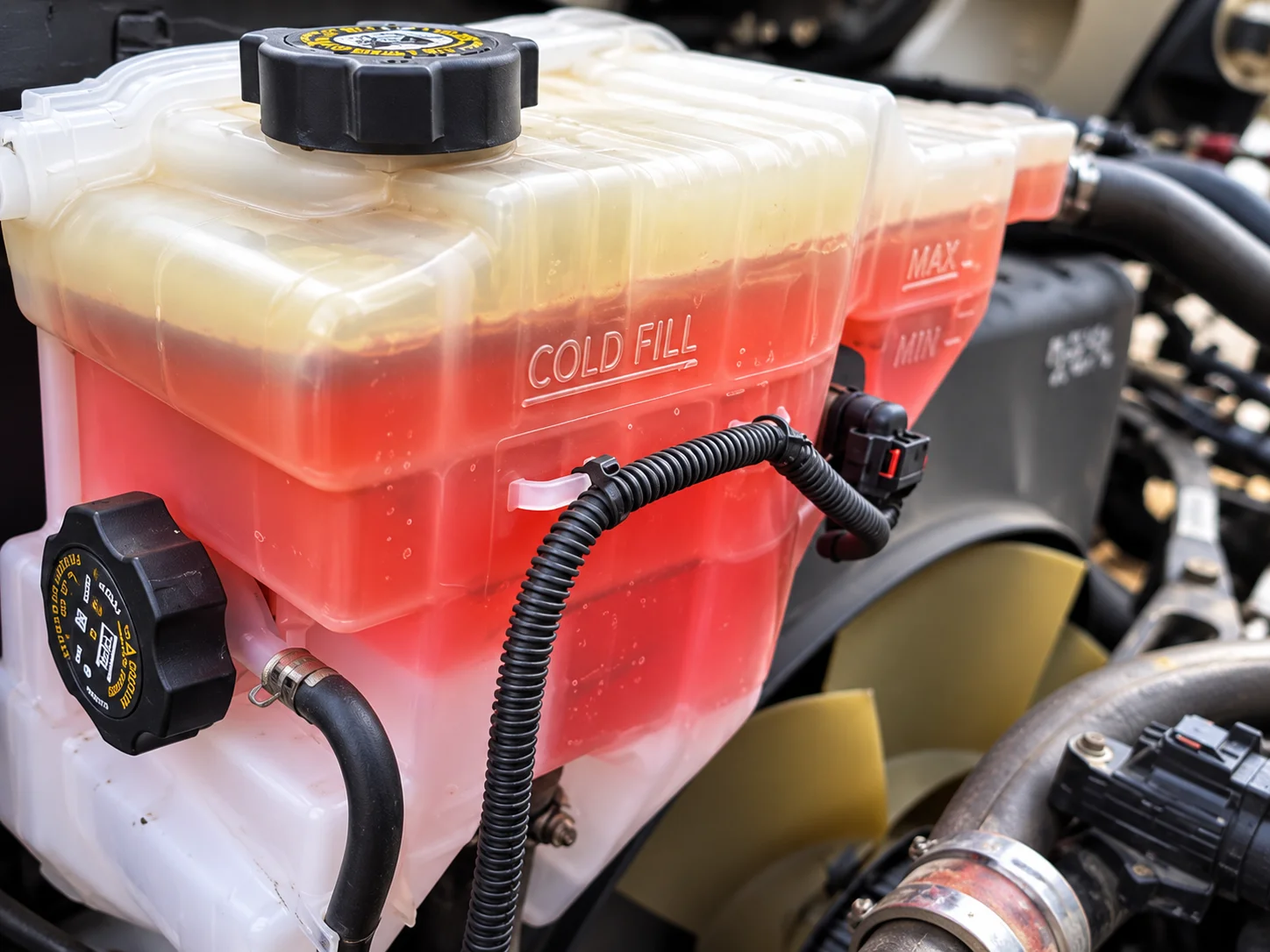
Coolant selection on a Detroit DD15 or DD16 deserves more attention than grabbing the first heavy duty coolant on the shelf.
Detroit supports more than one coolant strategy across these engines. Its current DD-platform operator information lists Extended Life Coolant using Organic Acid Technology and Standard Life conventional coolant as factory-fill options for DD15 and DD16 engines. Detroit Power Cool Plus is listed as a service-fill option for the OAT system, while Detroit Power Cool is listed for the conventional system.
That distinction should guide the purchase.
At AJK Engines, we stock both Detroit Power Cool Plus 20L and Detroit Power Cool 20L. The correct choice depends on the coolant programme already being used in the truck, the maintenance history and whether the system is staying with its current chemistry or being properly converted.
A DD15 or DD16 does not automatically point to one drum.
The cooling system tells the rest of the story.
Which Coolant Should You Buy for a Detroit DD15 or DD16?
For a DD15 or DD16 already operating on an OAT extended-life coolant programme, Detroit Power Cool Plus is the matching Detroit service-fill option.
For an engine maintained with conventional Standard Life Coolant and supplemental coolant additives, Detroit Power Cool is the corresponding Detroit option. Detroit’s operator manual separates these two systems clearly.
We recommend identifying the coolant strategy before topping up, draining the system or ordering replacement coolant.
That one check can prevent a maintenance programme from becoming unnecessarily complicated.
Detroit Power Cool Plus for OAT Extended-Life Systems
Our Detroit Power Cool PLUS 20L, part number 23549215, is listed as a 50/50 extended-life ethylene glycol coolant formulated with nitrite-free Organic Acid Technology. It is supplied ready to use.
OAT coolant uses organic-acid inhibitors to provide corrosion protection and support an extended-life maintenance strategy.
For fleet buyers, the practical advantage is simpler long-term coolant management where the system has been specified and maintained around OAT chemistry.
Detroit identifies Power Cool Plus as a service-fill option for DD13, DD15 and DD16 engines using Extended Life Coolant.
Detroit Power Cool for Conventional Coolant Systems
Our Detroit Power Cool 20L, part number 23512140, follows a different maintenance approach.
It is a 50/50 premixed ethylene glycol conventional coolant that comes pre-charged with supplemental coolant additives, commonly called SCAs. It is also supplied ready to use.
Conventional coolant relies on inhibitor levels that require monitoring as the engine accumulates time and kilometres.
Detroit lists Power Cool as the service-fill option for DD15 and DD16 engines operating under a Standard Life Coolant programme.
The product still has a legitimate place in Detroit maintenance. Fleet operators already maintaining an SCA-controlled system may have sound reasons to continue with the same coolant strategy.
Detroit Power Cool Plus Makes Sense for an Existing OAT System
A buyer searching for “DD15 coolant” or “DD16 coolant” will often come across Power Cool Plus first.
That makes sense. Extended-life OAT coolant is widely associated with later heavy-duty cooling systems, and Detroit explicitly includes Power Cool Plus among its approved service-fill paths for these engines.
The key is continuity.
An existing OAT system should continue to be maintained with coolant that meets the required specification. Adding a conventional SCA-based coolant changes the chemical balance and the maintenance assumptions that go with it.
We therefore look at Power Cool Plus as part of a complete coolant strategy.
The truck’s service records should support that strategy. Workshop staff should know what coolant is being used. Replacement coolant kept on hand should match it. Future top-ups should follow the same specification.
That kind of consistency is especially useful across a fleet.
A coolant programme becomes much easier to manage once the maintenance team is no longer trying to work out what somebody poured into a truck six months earlier.
Running Conventional Coolant? Detroit Power Cool Still Has a Clear Role
Conventional coolant is maintained differently.
The Detroit Power Cool we stock is pre-charged with SCAs. These additives provide protection against corrosion and mechanical wear, and their concentration changes through normal engine operation. Detroit’s technical material explains that SCA levels need to be replenished as required.
That creates a more active maintenance programme than an OAT system.
It also means an engine already operating successfully under that programme should not be casually switched because another coolant has “extended life” printed on the label.
A Coolant Change Is a Maintenance Decision
Moving from conventional coolant to an OAT strategy involves more than draining enough coolant to make room for a top-up.
The system needs to be suitable for the new chemistry and the conversion process needs to be carried out correctly. Residual conventional coolant can undermine the expected benefits of the extended-life product.
We have covered the chemistry in more detail in our Detroit Power Cool Plus vs Detroit Power Cool guide. The two products use different additive strategies, and our comparison specifically warns against intentionally mixing the OAT and conventional products.
For a maintenance buyer, the safest purchasing sequence is straightforward:
- Identify the coolant family already being used.
- Confirm the engine’s applicable Detroit coolant requirements.
- Match the top-up or replacement coolant to that system.
- Treat a chemistry change as a proper cooling-system maintenance job.
A drum of coolant is inexpensive compared with the consequences of poor cooling-system maintenance.
Check What Is Already in the DD15 or DD16 Before You Top It Up
An unknown coolant history is a warning sign.
We would rather help a customer identify the existing system than sell a product based on an assumption.
Maintenance records are the first place to look. Check previous service invoices, workshop notes, coolant purchase records and any fleet servicing documentation that identifies the product used during the last drain and refill.
The product label or container used for fleet top-ups may also provide an answer.
Colour alone is a weak basis for a technical decision. Dye colours vary between products and manufacturers, and colour does not replace a coolant specification.
If the system history is unclear, further inspection may be appropriate before adding a significant volume of coolant or changing chemistry.
Detroit itself advises users to check the coolant specifications before replacement or top-up to avoid potential engine damage from inadequate or over-concentrated coolant.
That caution is worth following.
Mixing Coolant Strategies Can Create a Maintenance Problem
OAT and conventional coolant are managed differently.
Our existing Detroit coolant comparison explains that intentionally mixing the two should be avoided. Detroit guidance cited there indicates that contamination with conventional coolant can remove the extended-life benefits associated with an OAT programme, leaving the system to be maintained under conventional coolant practices.
For a fleet, that creates another problem: uncertainty.
One technician believes the truck is on extended-life coolant. Another starts performing conventional SCA maintenance. The service history becomes harder to interpret, and future top-ups become another opportunity for inconsistency.
Good maintenance records prevent that drift.
We recommend recording the coolant family used at each drain and refill, particularly across fleets with multiple Detroit-powered vehicles.
Coolant Problems Can Point to a Bigger Cooling-System Issue
A DD15 or DD16 that repeatedly needs coolant deserves investigation.
Normal maintenance and a persistent coolant-loss problem are two different situations.
Continually adding fluid may hide a leak, hose problem, cooling-system component fault or another condition requiring diagnosis. A maintenance team can easily become focused on finding the correct coolant while the reason the reservoir keeps dropping receives less attention.
The cooling system itself contains several components that deserve consideration.
Our DD15 exchange-engine package, for example, includes work around the oil cooler, coolant thermostat and coolant pump as part of the rebuilt oil filter module. The engine is then assembled to Detroit specifications.
That gives useful context to coolant maintenance.
Coolant condition matters. So do the components moving it, controlling its temperature and keeping it inside the engine.
Repeated coolant loss, abnormal operating temperature or contamination should therefore trigger diagnosis rather than a routine top-up cycle.
Cooling-system faults can also have broader safety implications. The NSW Environment Protection Authority reports that more than 200 trucks catch fire each year in NSW, with many of these incidents considered preventable. NSW transport safety guidance also identifies engine coolant leaks as a potential fire risk when coolant reaches sufficiently hot engine or exhaust components.
Build a Coolant Programme the Whole Fleet Can Follow
Fleet maintenance gets harder when every vehicle has a slightly different undocumented servicing history.
Standardisation helps.
If several compatible DD15 or DD16-powered trucks use the same approved coolant strategy, keeping the correct product in the workshop reduces confusion. Service staff know which drum belongs in which vehicles. Purchasing becomes simpler. Maintenance records become easier to follow.
We also recommend documenting coolant changes with enough detail to be useful later.
Record the product, chemistry, date, vehicle and relevant maintenance work. A future technician should be able to look at the record and understand whether the cooling system is being managed as OAT extended life or conventional SCA-based coolant.
Routine inspections should also look beyond coolant level.
Hoses, clamps, signs of leakage, contamination and unexplained consumption all deserve attention. A stable coolant level gives the maintenance team far more confidence than repeatedly correcting a low reservoir without finding the cause.
Buying Heavy Duty Coolant for a DD15 or DD16 Should Be a Specification Decision
Search engines can make coolant selection look simpler than it is.
Someone searches “best DD15 coolant”, sees Detroit Power Cool Plus and assumes the extended-life product must be the universal answer.
Detroit’s own documentation shows a more precise picture. DD15 and DD16 engines may use an OAT Extended Life Coolant strategy or a conventional Standard Life Coolant strategy, with Power Cool Plus and Power Cool listed as the respective Detroit service-fill options.
That is the decision framework we use.
For an existing OAT system, Power Cool Plus is the obvious Detroit product to investigate.
For an existing conventional system, Power Cool remains relevant.
For an unknown system, confirm the coolant history first.
Three situations. Three clear paths.
Order the Detroit Coolant That Matches Your Maintenance Strategy
We stock both Detroit coolant options for buyers maintaining DD15 and DD16 engines.
Our Detroit Power Cool PLUS 20L is a ready-to-use 50/50 extended-life OAT coolant, part number 23549215.
Our Detroit Power Cool 20L is a ready-to-use 50/50 conventional coolant pre-charged with SCAs, part number 23512140.
If you already know which coolant programme your engine uses, selecting the matching product is straightforward.
If the maintenance history is unclear, contact us before ordering. Give us the engine details and any information you have about the coolant currently in the system. We can help narrow the choice so the purchase fits the maintenance strategy already being used.
That is a better outcome than trying to correct the coolant choice after the drum has been opened.
Questions to Settle Before the Next DD15 or DD16 Coolant Change
Can I use Detroit Power Cool Plus in a DD15?
Detroit lists Power Cool Plus as a service-fill option for DD15 engines using an Extended Life Coolant OAT system. We recommend confirming that the engine is already using that coolant strategy, or that the system has been correctly converted, before adding it.
Is Detroit Power Cool Plus suitable for a DD16?
Yes. Detroit’s DD-platform coolant table includes the DD16 and lists Power Cool Plus for the OAT extended-life coolant path. The existing coolant system and maintenance history still need to match that choice.
What is the difference between Detroit Power Cool Plus and Detroit Power Cool?
Power Cool Plus is an extended-life ethylene glycol coolant using Organic Acid Technology. Our Power Cool Plus 20L product is a 50/50 ready-to-use formulation. Detroit Power Cool is a conventional 50/50 ethylene glycol coolant pre-charged with supplemental coolant additives.
Can I mix Detroit Power Cool Plus and Detroit Power Cool?
We do not recommend intentionally mixing them. The products use different coolant strategies, and Detroit guidance referenced in our comparison explains that mixing conventional coolant into an OAT system can remove the extended-life benefit. If the coolant history is uncertain, identify the existing system before topping up.
Is Detroit Power Cool Plus already mixed with water?
The Detroit Power Cool Plus 20L product we sell is supplied as a 50/50 premixed coolant and is ready to use. There is no need to create your own 50/50 mixture from this product.
What should I do if my DD15 or DD16 keeps losing coolant?
Persistent coolant loss needs more attention than repeatedly topping up the reservoir. Check the cooling system for leaks and component problems and arrange diagnosis where the cause is not obvious. The correct coolant will not correct a fault that is allowing coolant to escape.
Where can I buy Detroit coolant for a DD15 or DD16?
We stock Detroit Power Cool Plus 20L and Detroit Power Cool 20L through AJK Engines. Both products are available through our online catalogue, and customers who are uncertain about the correct coolant can contact us with their engine and maintenance details before ordering.